How many stars are there really in the sky that we look at every night? The answer is very different from what a normal evening spent in the city might suggest, when by looking up we can only make out a few bright spots, the Moon and, in the best conditions, a few particularly bright planets. Yet what we see represents only a very small part of what is actually above us. The night sky is much richer than our eyes can perceive, and this very difference between what exists and what we can see is perhaps one of the most fascinating aspects of astronomical observation.
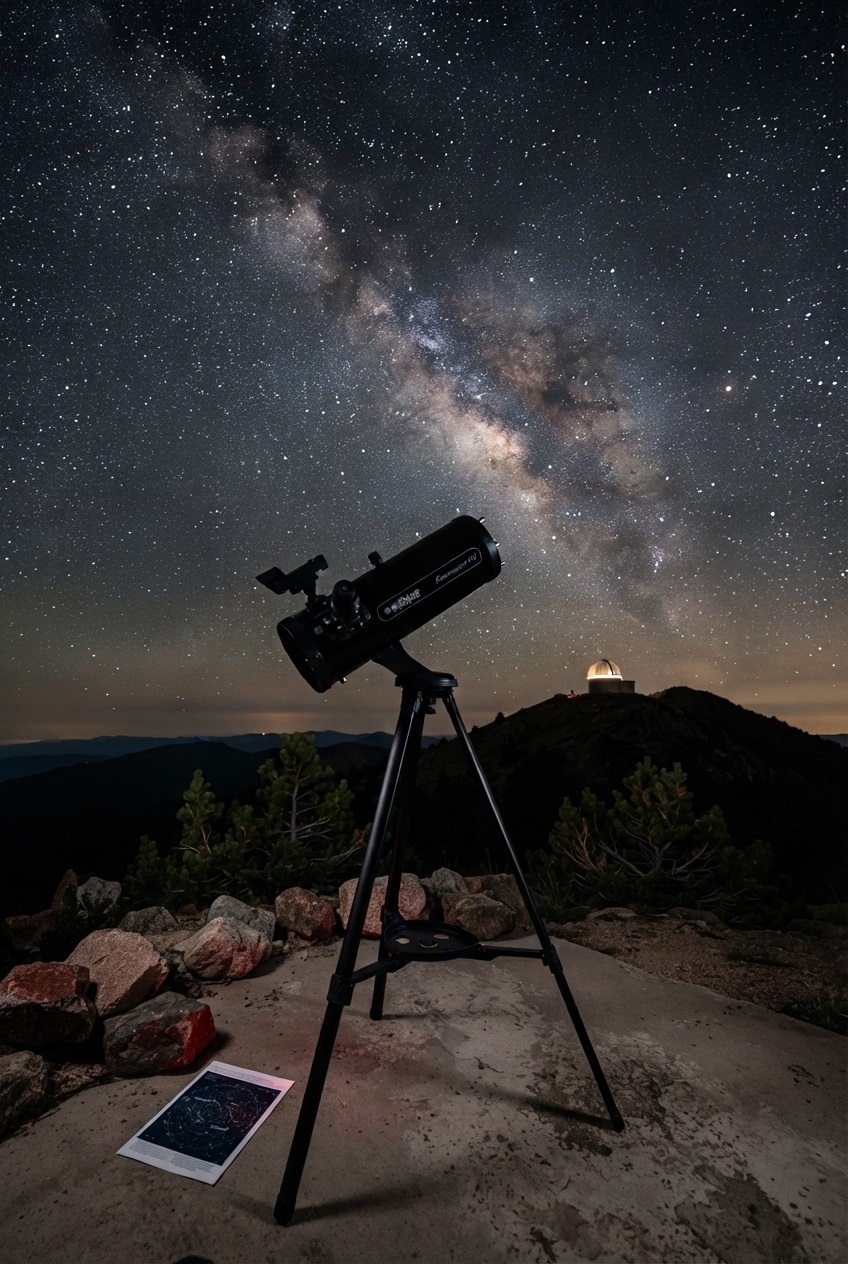
It is precisely at this moment that the telescope changes the way we look at the sky. Its task is not simply to make an image larger, as the concept of magnification might suggest, but above all to collect a greater amount of light than our eye is able to collect on its own. It is this ability that allows us to bring to our attention objects that to the naked eye would be too faint or too small to be recognized and that transforms a simple observation of the sky into something much more engaging.
To get into astronomy, however, you don’t need to start with a complex instrument or even be an expert. One of the reasons why astronomical observation can become a passion is precisely the possibility of starting simply and gradually increasing the level of experience. A first telescope can also be thought of for a child who wants to transform curiosity about the sky into a first concrete experience, perhaps starting with the Moon and gradually learning to recognize what he is observing. For an adult who wants to get serious about observation, there are more complete beginner’s instruments, easy to use and already equipped with the necessary accessories to get started without having to know all the technical characteristics of amateur astronomy from the beginning. And for those who, after their first experiences, discover they want to delve deeper, the range can accompany this path with intermediate-level models that offer greater possibilities and greater flexibility of use.

Ease of use is especially important for those who buy their first telescope, because an instrument that requires too much knowledge before it can even be used risks turning initial enthusiasm into frustration. The idea is instead to be able to start observing with what is already supplied, using the accessories included with the telescope to exploit its main possibilities right from the start. It is therefore not necessary to build your configuration from scratch by immediately purchasing numerous components whose differences are barely known, especially at the beginning.
The Moon, for example, can also be observed very differently depending on the phase it is in and the magnification used. When full, the entire surface appears illuminated, but right in the areas near the boundary between light and shadow, called the terminator, reliefs and craters can be particularly evident thanks to the shadows they produce. Changing the eyepiece and changing the magnification therefore also means changing the way you observe the same subject, and this possibility makes the telescope an instrument that can accompany curiosity even after the first experiences.
Konus telescopes are designed to accompany this route, offering easy-to-use instruments that are already complete to get started, but also the possibility of expanding the configurations over time through optional accessories. From models dedicated to younger people to telescopes for adult beginners, to intermediate-level instruments, the goal is not to transform the observer into a professional astronomer, but to allow them to do something much simpler and at the same time much more important: start really looking.
Sometimes to discover a completely different sky you don’t have to go any further.
Just bring it closer.