Two hundred and twenty grams or seven hundred and sixty? At first glance, it might seem like a strange question to ask when choosing binoculars. Yet those 540 grams of difference tell much more than it seems. They tell how we will use that instrument, how long we will keep it with us and above all what we expect from what we will see through its lenses.
When you think of binoculars, in fact, it’s easy to focus almost exclusively on magnification. 8x, 10x, 12x: the more the number grows, the more it seems like the instrument necessarily needs to be better. But enlargement is only part of the story. Binoculars are primarily used to better see something at a distance, and to do so, they must strike a balance between magnification, field of view, brightness, size, weight, and ease of use.
There is therefore no better binoculars than all of them. There are binoculars that are best suited to the way we want to use them.
Take, for example, a classic 10×42. The first number indicates the magnification, the second the diameter of the lens expressed in millimeters. A 10×42 therefore magnifies ten times compared to naked-eye vision and uses 42 mm lenses. But two binoculars that share this configuration can be very different instruments.
Konus’ Titanium OH 10×42 weighs 450 grams. It is a roof prism binocular with a modern open deck, designed to offer a good balance between size, weight and performance. It uses BAK-4 prisms, multi-treated optics, extra-large eyepieces and long eye relief and is moisture resistant. The field of view is 98 meters at 1,000 meters, while the exit pupil is 3.7 mm.

Alongside the 10×42, the Titanium OH 8×42 is also available, which maintains the same weight of 450 grams and the same lens configuration, but reduces the magnification from 10x to 8x. The difference is especially noticeable in the field of view: 122 meters at 1,000 meters versus 98 meters in the 10×42.
They are two very similar tools, but this small comparison alone allows us to understand something important. Going from 8x to 10x means getting closer to what we are observing, but it also means having a narrower field of view. With 8x you have a broader view of the scene; with 10x you can focus more attention on one detail.
But what if weight isn’t the first concern?
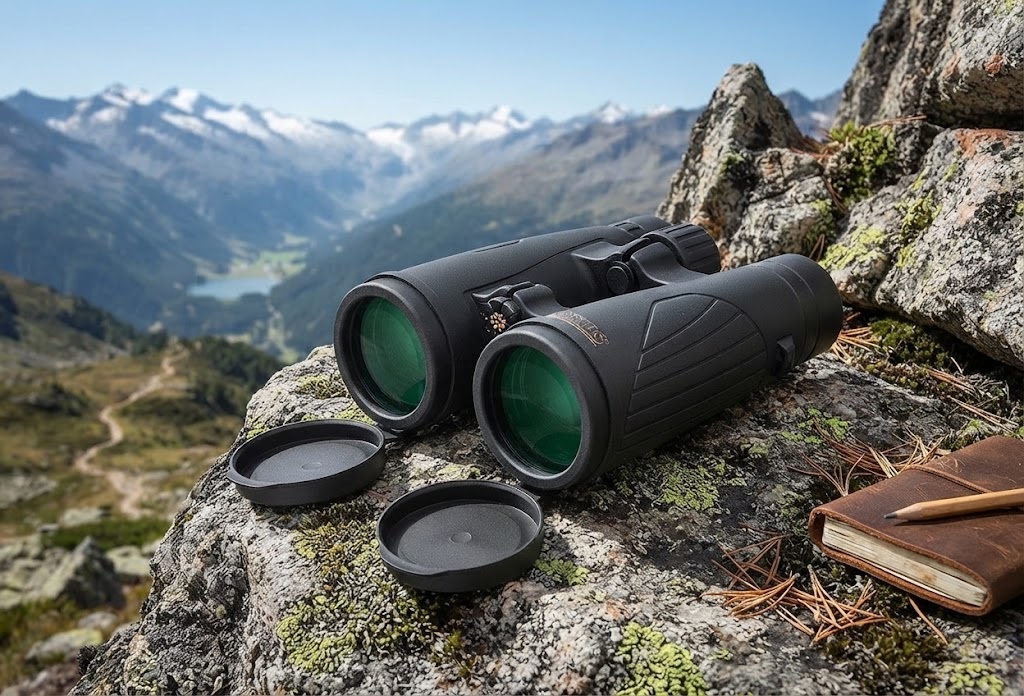
This is where binoculars like the Emperor 10×42 come in. This model also uses 10x magnification and a 42mm lens, so on paper it might look very similar to the Titanium OH 10×42. It actually weighs 760 grams: over 300 grams more.
What are those grams for?
I’m not just “overweight.” The Emperor was designed with performance, durability and comfort in mind. It uses a metal body, BAK-4 phase corrected prisms, multi-coated fully optics, is filled with nitrogen and is completely waterproof. The central focus system, long eye relief and screw-motion eye bonettes complete a construction designed for more demanding use.
What if the top priority was to have something you can’t feel in your backpack?
In this case the speech changes completely.
The Orient 10×25 weighs just 220 grams. It is a compact open-bridge binocular, with multi-treated optics, rubber coating and central focus. The field of view is 96 meters at 1,000 meters and the exit pupil is 2.5 mm.

But there is also another possibility.
What if we don’t need to look through two eyepieces?
The monocle starts from this very idea. A single tube, a single eyepiece, a more essential body and often an extremely light weight. It’s not simply a “half-binocular”: it’s a tool that can be used differently and that, thanks to its construction, can achieve interesting magnifications while maintaining small dimensions.
The Konusmall-2, for example, offers a 7x to 17x zoom with a 30mm lens, weighs just 156 grams and features a dual focusing system, with fast and fine adjustment. It is also tripod-ready and comes with a case and strap.
In this way the monocle is not only used to see a distant subject. It can also become a way to try to photograph or film it using your smartphone through the eyepiece. Landscapes, animals, architectural details, panoramas, or distant details can thus be transformed into images to be preserved or shared.

And this is precisely the central point of choosing between binoculars and monocles.
Binoculars offer both-eyed viewing, a generally more natural experience and particularly pleasant when viewed for extended periods. The monocle, on the other hand, can be lighter, more compact and easily transportable, and some models allow for very high magnifications in extremely small dimensions.
There is therefore no winner between binoculars and monocles. They are simply two different ways of observing.
And perhaps this is the most important thing to understand before purchasing optics: you don’t have to start from the product, but from the experience we want to have.
And that’s precisely why, in front of a display case full of binoculars and monocles, stopping at the magnification number isn’t enough. An 8x is simply not less than a 10x, just as a 24x monocle is not automatically better than 10x binoculars. They are tools designed to do different things and, above all, to be used in different situations.